Web3
From Blockchain to the Future of Retail
A BANANOW-style reflection on how blockchain and real-world asset tokenization may reshape retail, funding, loyalty, and ownership models.
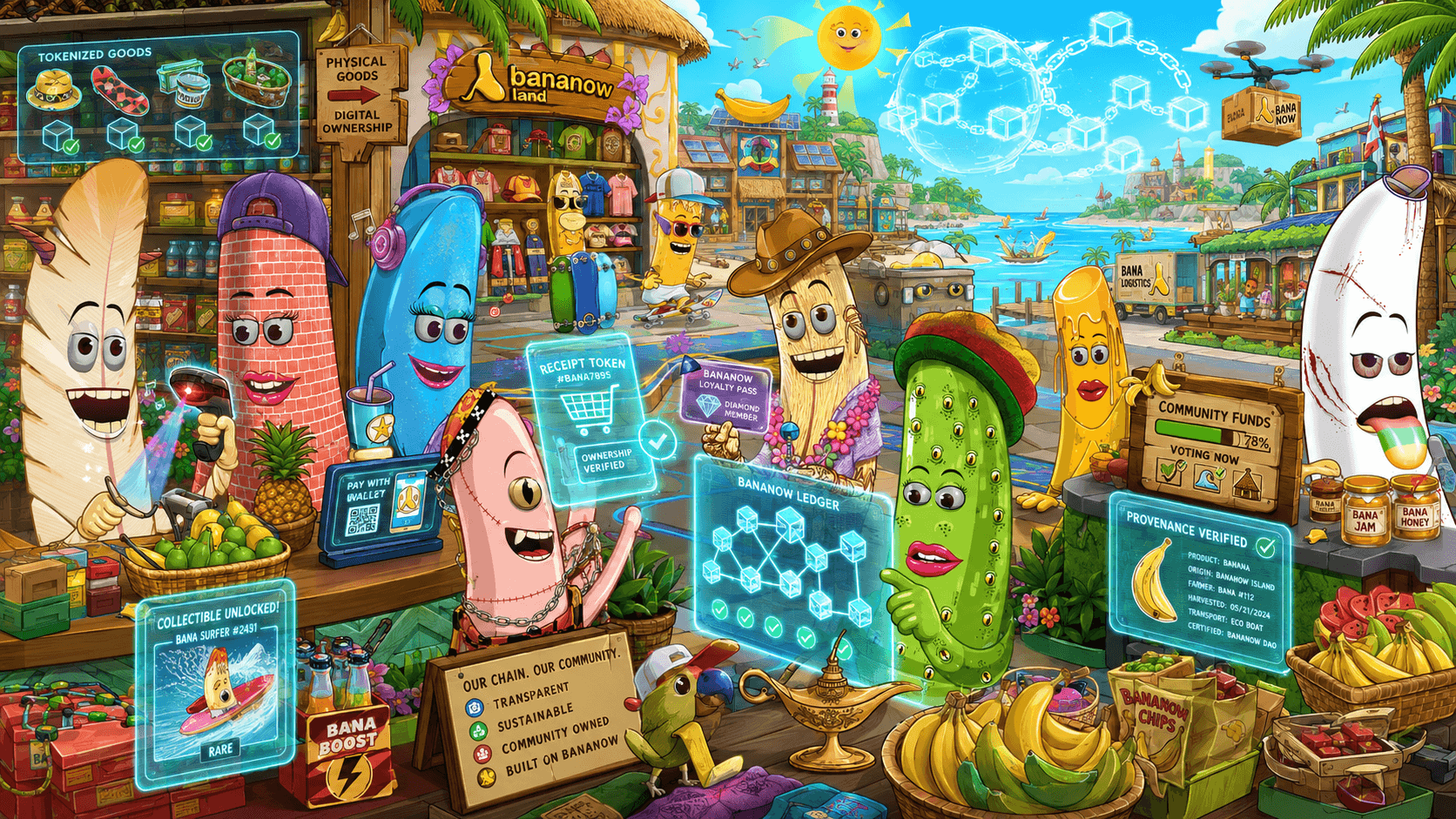
Hi, OiOi Fams!
Imagine a retail world where the boundary between physical goods and digital ownership becomes thinner. A store is no longer only a store. Inventory is no longer only inventory. A loyalty point is no longer only a number trapped inside one company database.
Blockchain makes people ask a strange but important question: what if parts of the real world can be represented, verified, and coordinated through digital tokens?
That question is the seed behind real-world asset tokenization.
For retail, it can become more than a buzzword. It can become a new way to think about funding, loyalty, community participation, product provenance, and shared economic coordination.
But like every seed in the Land, it must be planted carefully.
Blockchain as a Business Layer
Blockchain is not only about speculation. At its best, it is an infrastructure for shared records, transparent ownership, programmable rules, and public verification.
For businesses, that means new design patterns:
- transparent transaction records;
- tokenized access or participation;
- digital proof of ownership;
- loyalty systems that can move beyond one closed platform;
- community-based funding experiments;
- traceable product histories;
- new relationships between brand, customer, and contributor.
In retail, the most interesting question is not “Can we put everything on-chain?”
The better question is: “Which part of the retail experience becomes more fair, transparent, useful, or fun when it is connected to an open digital record?”
Retail Assets as Digital Signals
Real-world asset tokenization means representing some form of real-world value, claim, right, or participation as a digital token.
In retail, possible experiments may include:
- inventory-backed participation;
- membership tokens;
- product provenance certificates;
- collectible receipts;
- franchise or partner coordination;
- loyalty tokens;
- access passes;
- community reward systems.
The promise is attractive: broader participation, more flexible funding, stronger customer engagement, and a deeper connection between physical commerce and digital identity.
But this is not magic.
Tokenization does not automatically make a business healthy. It does not automatically make an asset valuable. It does not remove legal obligations. It does not replace trust, operations, supply, demand, customer service, or responsible governance.
The Retail Opportunity
For a small brand, tokenization may open creative ways to invite community participation.
A café could create collectible membership receipts. A skate shop could issue limited access tokens for events. A local product maker could use blockchain to show provenance. A community marketplace could use NFTs as identity signals. A retail group could experiment with loyalty that is more portable than old points.
The heart of it is not the token.
The heart is participation.
Retail is not only a transaction. Retail is a relationship. People buy because they need, but they return because they trust, feel, belong, and remember.
Blockchain can help record some of that relationship in the 0101 Universe.
The Challenges
The road is not simple.
Regulation matters. If a token looks like a financial product, security, investment contract, or revenue promise, it may trigger legal obligations. Businesses must not casually tokenize assets without understanding the regulatory frame in their jurisdiction.
Technology matters too. Wallets, fees, user experience, smart contract safety, chain choice, and data permanence can create friction.
Market maturity is another challenge. Many customers still do not want to manage wallets, private keys, gas fees, or blockchain explorers. If the Web3 layer makes the experience harder, the retail experience may fail.
That is why BANANOW believes in friendly bridges. Web3 should not be a locked temple. It should be a path ordinary people can walk.
A Safer Direction
For early retail experiments, the safest path is usually not to promise profit. It is to start with utility, memory, verification, participation, or community identity.
Good early questions:
- Can this token help people verify something?
- Can it make membership clearer?
- Can it make a receipt more meaningful?
- Can it help community coordination?
- Can it reduce fraud or confusion?
- Can it make the brand story more alive?
Bad early questions:
- Can we promise returns?
- Can we hype the price?
- Can we sell future benefits we cannot guarantee?
- Can we make people buy because they fear missing out?
BANANOW Land chooses the healthier route: Web3 as a literacy layer, not a trap.
Closing
The future of retail may not be fully on-chain. But parts of retail will become more digital, more verifiable, and more connected to community identity.
The businesses that survive will not be the ones that shout “blockchain” the loudest.
They will be the ones that understand what blockchain is actually good for, where it should stay invisible, and how to make people feel safer, not more confused.
From blockchain to retail, the seed is already in the soil.
Now the real question is how we grow it.