Arts
The Latest Developments in AI and Its Progress in the Realm of Art
A BANANOW reflection on AI video generation, OpenAI Sora, creative tools, artists, and the tension between possibility and responsibility.
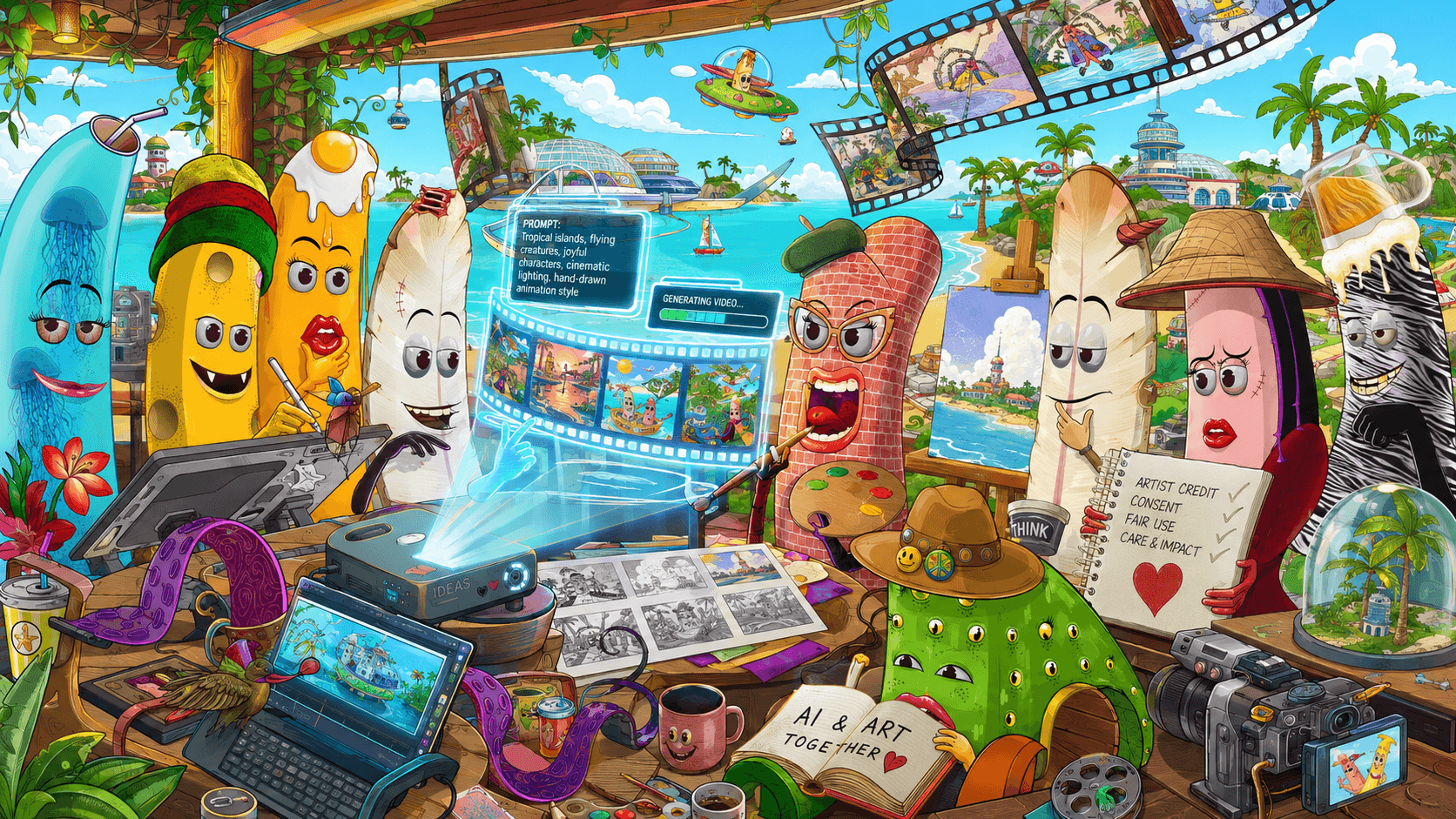
Hi, OiOi Fams!
Even in BANANOW Land, where the bananas are playful and the soil remembers strange things, we cannot ignore the rapid development of AI in the world of art.
One of the biggest conversations in early 2024 was OpenAI’s Sora, a text-to-video model that showed how quickly generative tools were moving from still images into motion, scene, camera, atmosphere, and cinematic imagination.
This article is a reflection on that moment: not only what the tool can do, but what it means for creators.
What Is Sora?
Sora was introduced as a model that can generate video from text prompts. The public examples showed scenes with camera movement, realistic environments, detailed subjects, and a sense of visual continuity that made many people stop and stare.
For creators, that is exciting.
For creators, that is also unsettling.
If a prompt can generate a video that once required a team, budget, location, camera, post-production, and time, then the creative industry must ask new questions.
Who becomes more powerful?
Who becomes more replaceable?
Who owns the visual language?
Who gets paid?
Who gets erased?
Why Artists Are Paying Attention
Artists are not afraid only because AI can generate beautiful things. Many artists are afraid because AI systems may learn from human work without meaningful consent, credit, or compensation.
This is why AI art is not only a technical topic. It is also an ethical topic.
A tool may be impressive and still raise hard questions.
A model may create beauty and still depend on the labor, style, memory, and archives of human creators.
BANANOW Land sees this tension clearly: future literacy must include both skill and conscience.
Possibility and Responsibility
AI video generation can help small creators. It can lower production barriers, help with storyboarding, create visual references, assist independent filmmakers, support educators, and open new creative workflows.
But the same tool can also flood platforms with synthetic content, blur trust, imitate styles, generate misinformation, and weaken the value of human-made work if handled carelessly.
That means the future is not simply “AI is good” or “AI is bad.”
The future asks for better rules, better literacy, better consent systems, better creative credit, and better public understanding.
What This Means for BANANOW
BANANOW is playful, but not blind.
We can enjoy creative tools while still respecting artists. We can experiment with AI while still defending human dignity. We can use technology while still asking where it came from, whose work trained it, and who benefits from it.
The Land does not want a future where creativity becomes only a prompt economy controlled by giant platforms.
The Land wants a future where tools help people create without making people invisible.
A New Creative Literacy
The next generation of creators may need to understand:
- how prompts shape output;
- how models are trained;
- how synthetic media can mislead;
- how to protect creative identity;
- how to combine human direction with machine assistance;
- how to credit, disclose, and respect sources;
- how to build work that is not only fast, but meaningful.
That is not only AI literacy.
That is cultural literacy.
Closing
AI video generation is a powerful seed. It can grow into a helpful tool, a noisy weed, or a forest owned by a few.
The outcome depends on how humans use it, question it, regulate it, and teach one another about it.
In BANANOW Land, the answer is not to run away from AI.
The answer is to face it with care, play, and responsibility.